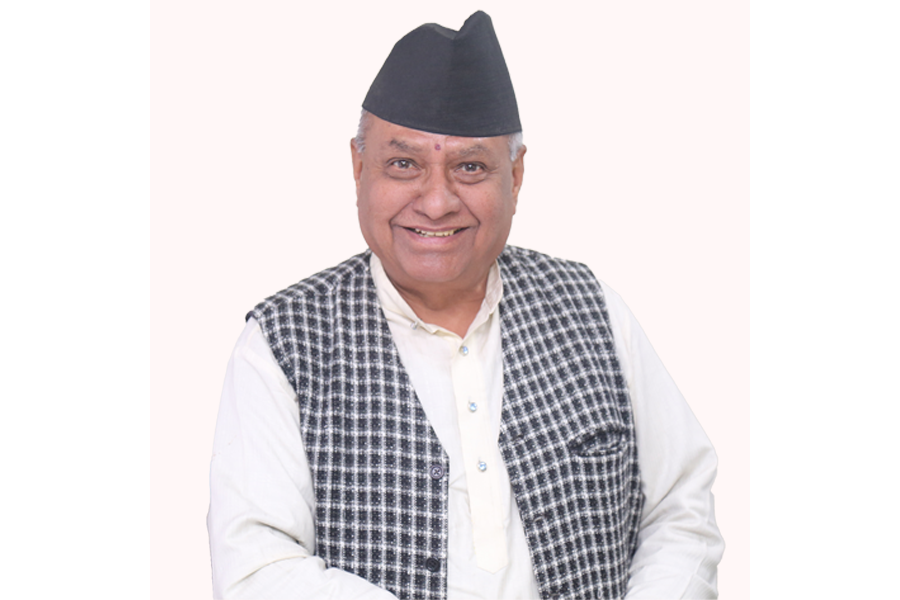
Bharat Jangam is a well-known name with imitative fame in the entire world, was born on 25th Nov,1947 (2004 B.S.) in historically and architecturally renowned city, named as Bhaktapur, now Mr. Jangam is currently residing at New Baneshwor, Kathmandu. He has his footsteps in different sectors in different period. In a nutshell, he is a nationalist, think-tank, journalist, writer, literary figure, social activist, historian, cultural specialist and jurisprudent, campaigner of anti-corruption movement and instigator of neo-science, "Anticorruptology". He started writing literary works since his childhood. At the early age of 15, he published poems in the local literary magazine for the first time and gradually stories, essays etc. were published. Right after the graduation from Tribhuvan University in 1970 he exposed himself as a journalist in Nepal.
In 1979, he made a sensation in the country by releasing his first historical novella “KALO SURYA” (The Black Sun) even though the country was ruled by the corrupted aristocrats, feudal, ‘Panche’ leaders and bureaucrats of the Partyless Panchayat System. While criticism, arguments, think-tank discussion, voice, revolution throughout the literary work or art of writing against the system and policy also used to be considered as a concerned crime. In such a devastative life thriving scenario, he published his novel that explains the exploitation and suppression by so-called rulers of existing autocratic regime in authoritarian system. Novel gained popularity in a short span of time amongst the Nepalese Readers along with entire society and to make it acquainted along with the foreign readers. It's translated into English Language in 1990 and came into the world market as a ‘THE BLACK SUN’. Later in 1992, it's translated into Russian and Chinese Languages and in 1993, it re-launched out in the market in Hindi Language named as ‘KALA SURAJ’. Thus, it was translated and published in Bangla and Urdu languages in Bangladesh and Assami and Kanada languages in India.
Jangam’s following literary fiction, ‘BYUHA CHAKRA’ (The Vicious Circle) was written in 1984. In the art, he has given a transparent viewpoint and perspective of the aristocratic rulers, nonpolitical system and has pointed out its weaknesses. This book is mainly based on the monstrous circles of all kinds of corruption caused by the ruthless autocratic rulers of the Partyless Panchayat System that crumbled during recent “Democratic Uprising”. The novel became renown inside the literate arena and in the country, was later translated into English and Hindi Languages in India.
He was also an Editor and Publisher of the weekly newspaper ‘NEPAL AWAZ’ for 3 years form 1988 and made great contribution in the development and stability of the democracy in the country throughout Journalism. He was also a regular columnist in several medias on contemporary political situation of Nepal and later it was consolidate in a book and was released in the name of ‘PACHAS PRASANG’
In 1993, he released another novel ‘RATO GHAM’ (The Red Sun), an unique novel that the plot surrounds in the uprising socio-economic problems inside of Greater China after 1949′s great revolution as well as after the implementation of Mao-Tse-Tungs’s neo-proletarian thoughts in the nation. It also focuses on the pitiable condition of the Tibetan people after the invasion of the Tibet and exposes fatal circumstances and status of the ‘Human Rights Violation’. In the novel, Mr. Jangam has indirectly urged for the liberation of 1.5 billion people of China who has been suppressed by the Communist Regime. He has given his direct perspective that any decision that is created or invented by human mind is not, and cannot be, full and final. Human being keeps willing to change at every pace, it’s the naturalistic philosophy. Human mind keeps itself suffering, being tortured, and waste it’s essence in the process of attaining the novelty of social dogmas. Life means to live or ‘living’. It is bounded by jurisdiction of time, due to this limited factor of the living standard, there is a multitude of hopes and desires after which human beings find themselves hankered, and this is the fountain-head form which springs the temptation for the novelty.
Even being a foreigner, he has succeeded to narrate the realism of ins and outs of contemporary China which until very recently, was closed for the foreigners and is successful in letting us know-how China looks outside, its peripheral spheres, what actually China is and Is Communism really good for the nation and its people? After receiving commendation and popularity from all surroundings of intellectuals, it was translated into English and Hindi Language in the same year in India. In the conclusion, we are proud to say that a humanist at heart, Mr. Jangam wields his pen with revolutionary zeal and for democratic rights and human values, he is extremely dedicated.
With his persistence and dedication over the last 4 decades, he has achieved the following status:
Bharat Jangam started his career in journalism in 2027 B.S. (1970 AD) and is continuing till now. He started by writing article in papers and gradually covered all major Nepalese daily newspaper like Gorkhapatra, Kantipur, Nepal Samacharpatra, The Himalayan Times, Lokpal, Rajdhani and so on. Similarly, he has worked as an editor & publisher of a weekly newspaper “Nepali Aawaj”. With these contributions in the long and illustrious field of journalism for such long he has gained the status of senior journalist.
Jangam enteredto the literary world with his well-known novella, ‘The Black Sun’ in 2036 B.S. (1979 AD) and gained an international recognition in the literary field within a short span of time. The Black Sun has been translated into several languages like English, Hindi, Urdu, Kannad, Aasami, Bengali, Japanese, Chinese, Russian, Maithili, Bhojpuri, Doteli, Newari and Sanskrit. He has published four novels namely The Black Sun, Byuhachakra, The Red Sun and Khowpadesh. Similarly, an anthology of short stories and some books of poetry & songs have also been published, Nirbandha Bandhan. Likewise, three anthologies of essays namely “Thought and Perspective”, “Fifty Context”, “Movement against corruption” have also been published. His prolific contribution to uplifting the Nepali literature on international arena has positioned him as prominent and senior literacy figure.
Having started social service from 2027 B.S. (1970 AD), Mr. Jangam established “Jangam Scholarship” in educational arena and provide the financial aids and assistance to the needy and laborious students, due to it, hundreds of students have been got benefit. He filed a case at Supreme Court in 2065 B.S. against the government interference in the worship custom at Pashupatinath and fought constantly to maintain the ancient culture and tradition. He stopped government’s attempt to capture to control on the treasure that belongs to the trust of Pashupatinath temple. Furthermore, he succeeded to abandon the Christians attempt to make burial site at Mrigasthali within the Pashupati area. It is also recognized as his effort to safeguard the natural resource and greenery of that holy land. Similarly, Mr. Jangam has great contribution to build and renovate various temples, monasteries, and public and religious shrines inside as well as outside of Kathmandu valley.
Jangam has been filing writ at Supreme Court about various matter of public interest since 2055 B.S. (1998 AD) and compelled the stake holders to make decision in favor of social welfare. Some major cases he filed at the court for safeguarding the social justice are as follows:
- Mr. Jangam filed writ in 2057 against the pension act for former members of parliament that was promulgated in 2052 B.S. and urged to end that privilege.
- The Supreme Court had repealed parliament development fund in 2058 B.S. That case was also filed by Mr. Jangam. But since 2065 B.S. the members of parliament have been spending budget from that fund illegally without any regulating act.
- Similarly, Supreme Court declared to stop government officials from taking dual facility in 2058 B.S. It was also the case filed by Mr. Jangam.
- Since the appealing right of commission for investigation of abuse of authority (CIAA) had been seized, the appealing right of CIAA was revived later by the writ filed by Bharat Jangam.
- The ordinance concerning privilege to former VVIPS and VIPS (2069 B.S.) proposed by the government led by Dr. Baburam Bhattarai was repealed. It saved millions of revenues to the government from these unnecessary expenses.
- The first constituent assembly extended its tenure unconstitutionally and was intending to extend it in again in 2069. But later the Supreme Court declared the deadline of that constituent assembly up to 14thJestha 2069. But the assembly failed to promulgate constitution during that time and was dissolved.
- Bharat Jangam was involved to file writ in all above-mentioned cases. Consequently, billions of budgets have been saved due to the court’s decision for the writ
As a chief patron of Doleshwor Mahadev Temple (Upper part of Kedarnath Temple), chief advisor of Pashupatinath volunteer union, chief patron of AnantaLingeshwor Mahadev Temple, Bageshwori and Saraswati Holy Land, Bharat Jangam has contributed a lot for the development of religious shrines of Nepal elucidate his guardianship over religious institutions.
Bharat Jangam’s Diamond Jubilee Ceremony Committee published ‘Immortal Personality Bharat Jangam’ in 2063 and organized a civil felicitation in his honor. Similarly, poet Yagyabalkya composed an epic named as ‘Bharatendu’ in 2064 B.S making Mr. Jangam as the living legendary protagonist of that poetry.
We can have witness various episodes of renown “Television Talk Show” ‘The Black Sun’ by Bharat Jangam. That Television program has proudly been accepted by governmental bodies, national and international agencies, private sectors, public and civil corporations, and other organizations. Jangam submitted his entire life to the anti-corruption campaign since 2027 B.S. (1970 AD), has succeeded to gift the pioneer book on anticorruption science, ‘Anticorruptology’ to the world to take it forward. Anticorruptology is the science of anticorruption and the book ‘Anticorruptology’ is the first attempt in the discipline in World Academia. We trust that ‘Anticorruptology’ would also be taught in universities of the entire world with having global significance. As this science was conceived by Mr. Jangam, he is also referred as “Father of Anticorruption” science.
Brief Biography in Chronological Order
- 1947: Born in ancient city Bhaktapur to Father Govinda Hari Jangam and Mother Indra Kumari Jangam
- 1960: Starting of writing poems and stories.
- 1961: Established of small local library in Bhaktapur for local students.
- 1963: The Very local library was moved to Baneswor, Kathmandu and baptized the name ‘Bhimsen Gola Pustakalaya’.
- 1970: After academic graduation, he exposed himself as a journalist and introduced himself as a regular columnist. He has taken part actively in various social clubs and youth organizations. He is a chartered member of ‘Lion’s International Club’, life member of ‘Red-Cross Society’ and many other local social organizations. Also, he leads the ‘Independent Thinking Forum’ as President and is a member of Pen International.
- 1979: Publication of ‘KALO SURYA’ (The Black Sun) in Nepali. Up to 2021 it is translated and published in 14 different languages.
- 1984: Publication of ‘BYUHA CHAKRA’ (A Vicious Circle)
- 1988: Role an editor and publisher of weekly newspaper ‘NEPALI AWAZ
- 1989: Nominated as President of Lions Club, Kathmandu Valley.
- 1992: Publication of ‘PACHAS PRASANG’ (a collection of political comments)
- 1993: Publication of ‘RATO GHAM’ (The Red Sun)
- 1993: Publication of ‘Nepali Congress Ko Samanya Gyan’ (A book of general knowledge of Nepali Congress Party)
- 1996: Started Anti-corruption Movement.
- 1999: Started Interaction program in colleges and Universities to develop a new subject ‘Science of Anti-corruption’
- 2001: A PIL was filed against the government for imitating Institutional corruption which involved pension for members of parliament. The court’s verdict come in his favor to stop the MP’s pension; it played the significant role to preserve nearly around millions of rupees of Nepal Government.
- 2002: A PIL was filed against the government for issuing an amount as ‘Constituency Development Fund’. The court’s verdict comes in his favor to stop it, which is saving millions of rupees of Nepal Government.
- Appointed ‘Chief Administrator’ for Narayani and Bagmati Zone by His Majesty’s Government of Nepal.
- 2004: Publication of ‘Bhrastachar: BaicharikAndolan’.
- 2005: A book named ‘Bharat Jangam: BaichartathaDristikon’ was published. It is a compilation of an articles and interviews of Bharat Jangam.
- 2007: An Epic ‘Bharatendu’ was composed by Poet Yagyabalkya in his honor.
- 2007: A public honor program was held on the occasion on Mr. Bharat Jangam’s 60th birthday, it honored him as a ‘Kaljaye Bektitwo Bharat Jangam’.
- 2008: Published Novel ‘Khopedesh’.
- 2009 to 2012: Multiple PIL was filed against the government in the Pashupatinath temple’s issues. The decision from court has done in his favor by stopping the government to open the ‘Mul Dhukuti’ of the temple, to remove the ‘Christians’ Graveyard from Pashupatinath area, and reinstating the traditional practice of priesthood from South India.
- 2009- 2021: Guardianship of Temples:
As a chief patron of Doleshwor Mahadev Temple (Upper part of Kedarnath Temple), chief advisor of Pashupatinath volunteer union, chief patron of Ananta Lingeshwor Mahadev Temple, Bageshwori and Saraswati Holy Land, Bharat Jangam has contributed a lot for the development of religious shrines of Nepal. - 2011: Published ‘Collection of Poems’ named ‘Chhachalkiyeka Rahar Haru’
- 2011: Started Nationwide movement from Mechi to Mahakali for awerness among public about ways to tackle corruption issue.
- 2012: Published ‘Collection of Short Stories’ named ‘Nirbandha Bandhan’.
- 2012: A PIL case was filed to end the timeline of first constituent Assembly of Nepal which ran from May 28, 2008to May 28, 2012. A court’s verdict was given on his favor by dissolving the first constituent assembly and ordering for election for the second constituent assembly.
- 2012: A PIL was filed against the act of handing over the public and Guthi property in lease, By the court order, a high-level corruption has ended.
- 2013: A PIL was filed against the Government to stop the benefits for ex-dignitaries. It annually saved 50 crore rupees of Nepalese Government.
- 2015: A book named ‘The thoughts of Bharat Jangam’ was published. It is a compilation of articles by Bharat Jangam.
- 2015-2018: Various episodes of the popular Television program ‘The Black Sun’ was started broadcasting the show. This Television program has proudly been accepted by governmental bodies, corporations, and other organizations.
- 2016: Authored ‘Anticorruptology’ is science of anti-corruption. It is registered in Library of Congress, Washington DC, USA.
- 2020: Approval from Tribhuvan University for the course ‘Governance and Anticorruption Studies’ for the Masters’ Degree, classes to begin from 2021. The finalization and initiation of curriculum has done by Bharat Jangam.
- 2021: Approval from Nepal Open University (NOU) for the course “Anti-corruption Studies” in the ‘Master’s Degree’.
- 2021: Published Book on history named ‘Nepal ko Itihasma Raheko Bhram Tatha Nirakaran’.
Personal
- 1975: Married to Indira KC of Dillibazar.
- 1976: Daughter Pragya Jangam was born.
- 1978: Daughter Rakshya Jangam was born.
- 1979: Son Anup Jangam was born.
Actively Involved Institution
- Life-time member of International Children Organization
- Life-time member of Red Cross Society of Nepal
- Active Lions of Lions Club District 325 Nepal
- President of The Forum of Independent Thinking
- Member of Pen International
- Life-time member of Nepal Literary and Journalist Association